

COP31 in Antalya: Morocco’s IRESEN Discusses Adapting Power Grids for Renewable Energy Integration
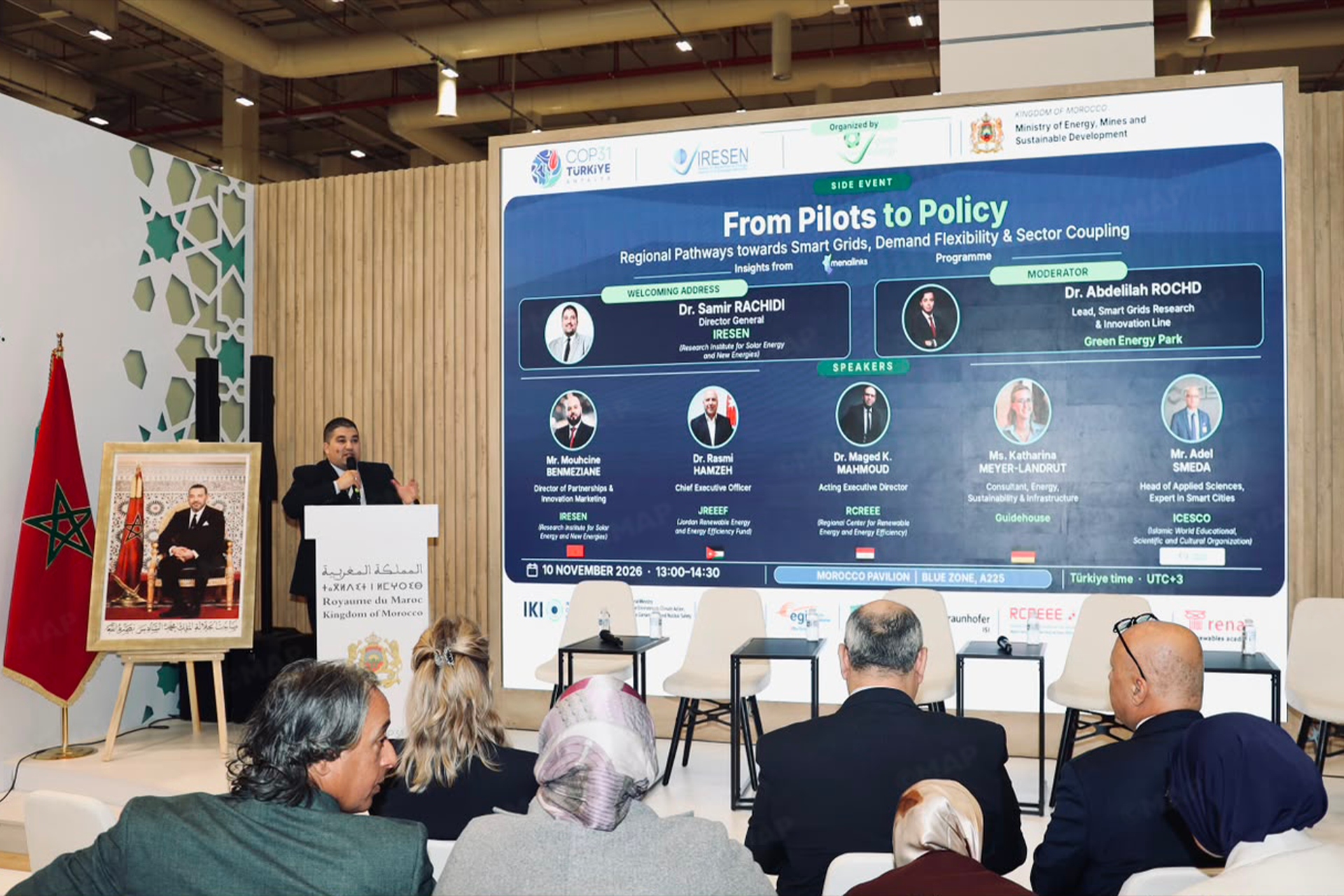
Antalya (Türkiye) – The adaptation of electrical networks to the massive integration of renewable energies and the development of energy flexibility solutions were the focus of discussions during a side event, organized by Morocco’s Research Institute for Solar Energy and New Energies (IRESEN) on Tuesday, within the framework of COP31 in Antalya.
During this side event, organized at the Morocco pavilion, under “From Pilots to Policy: Regional Pathways towards Smart Grids, Demand Flexibility & Sector Coupling”theme, the speakers highlighted the challenges related to transforming electrical systems in the MENA region, facing the decarbonization imperatives and the renewable energies’ progress, in particular solar and wind.
While their development is an essential lever for reducing greenhouse gas emissions and supporting climate objectives by 2050, their fluctuating nature and dependence on weather conditions pose new challenges to traditional electricity networks.
The central question raised during the discussions concerns the capacity of existing electrical infrastructure to welcome increasingly important renewable energy production, while ensuring the stability, security, and continuity of supply. Unlike conventional thermal power plants, whose output is dispatchable and can be adjusted to meet demand, solar and wind installations generate variable electricity, which can complicate maintaining a balance between supply and consumption.
This evolution highlights networks challenges, especially in stability, tension and frequency adaptation, energetic flows management, and new renewable capacities connections. Digitization and cybersecurity challenges also reinforce the need to modernize existing infrastructures.
For IRESEN Director General Samir Rachidi, Morocco, like other countries committed to reducing their carbon mark, is focusing on renewable energies, with a 52% target of installed electrical capacity by 2030. This ambition could even be exceeded, with a share likely to reach 60%, adapting the network to fluctuations in renewable production, he told MAP.
He also emphasized the need for a system capable of managing high solar energy production and of low availability periods, by leveraging various storage solutions such as batteries, thermal storage, and pumped storage hydropower. The digitalization of energy consumption also serves as a tool for usage modulation and demand flexibility increase, he explained.
Facing these challenges, the speakers emphasized the importance of evolving the traditional electricity management model towards smarter, more flexible, and decentralized systems. This transformation relies in particular on Smart Grids’ development, mobilizing digital technologies, communication systems, and automation to optimize the production, distribution, and consumption of electricity.
The head of IRESEN also spoke of bringing together scientific research, economic actors, and the industrial world to move from experimentation to concrete applications. In this regard, he cited the work carried out in Morocco, particularly within the Green Energy Park platform in Benguerir, around experimental models of smart cities and solutions enabling testing of flexible energy production and consumption.
Beyond smart networks and demand flexibility, the event’s theme also highlights sector coupling, an approach to strengthen interactions between various energy sectors, including electricity, transport, industry, and buildings, to improve the use of renewable resources and foster decarbonization.
Through this meeting, which was attended by renewable energy organizations’ leaders from Jordan and Egypt and experts from the consulting firm Guidehouse and ICESCO, the challenge is to move beyond the pilot project stage to promote their translation into public policies and regional deployment strategies.
Related Articles

China: Moroccan Research Team Wins Two Awards for Study on Valorising Argan Press Cake

Technical Delegation from Morocco’s Foreign Ministry Visits Syria to Operationalize Royal Decision to Reopen Embassy in Damascus

Morocco Reopens its Embassy in Damascus
UNHCR: Enjoying broad support, Morocco advocates for durable solutions for the Tindouf camps and calls for their dismantling
The Moroccan “Citizen Labs” Initiative in the Spotlight at the World Forum for Democracy in Strasbourg
Leave a Comment