

Former African Ministers Explore Promising Prospects of Royal Atlantic Initiative
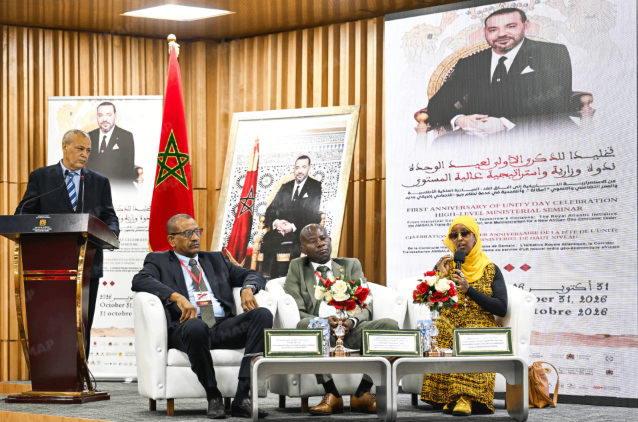
Es-Semara – Former African ministers, officials and experts gathered on Saturday in Es-Smara to examine the promising prospects offered by the Royal Atlantic Initiative in terms of integration, interconnectivity and co-development at the continental level.
During a panel held as part of an international conference on “Royal Initiatives for Africa: From Historical Continuity to Tomorrow’s Horizons,” organized in the wake of the celebration of the first anniversary of Unity Day, the various speakers emphasized the key role of the Kingdom’s Southern Provinces as a bridge linking West Africa, the Sahel and the Atlantic region.
In this regard, former Mauritanian minister Cheikh Saad Bouh Camara praised the Royal Initiative, describing it as “an extremely important strategic vision that brings to life a significant chapter of our shared history, namely the corridors that fostered communion among our brotherly peoples and enabled trade and human exchanges between our regions.”
He noted that this Royal Initiative reinforces existing continental integration mechanisms, which “enable us to strengthen our relations and move towards much stronger, more active and dynamic connectivity.”
Africa, which is emerging as the continent of the future thanks to its potential, dynamic youth and rapidly transforming economy, stands to gain considerably from such initiatives.
Along the same lines, Director General of the African Centre for Administrative Training and Research for Development (CAFRAD), Coffi Dieudonné Assouvi, stressed that the Royal Initiatives for Africa offer a successful model of project-based integration at the continental level.
He noted that the importance of the Royal Atlantic Initiative lies in its ambition to address the difficulties encountered by other initiatives, particularly with regard to the free movement of people and goods.
For her part, former Ethiopian minister Aida Tola Lensa Mekonnen said that Africa is called upon to develop through corridors and integrated territorial approaches, adding that structuring development initiatives such as the Royal Atlantic Initiative serve as the cornerstone of the continent’s growth and prosperity.
The initiative, she continued, has a far broader scope than one might imagine, as it promises to extend African prosperity across the entire continent, from east to south, north and west.
For his part, Director General of the French Chamber of Commerce and Industry of Morocco, Jean-Charles Damblin, stressed that the Amgala corridor, along with the various structuring initiatives launched by His Majesty King Mohammed VI, particularly the Dakhla Atlantic Port, offer tremendous opportunities for French companies by enabling them to access new international markets.
A genuine driver of regional integration and interconnectivity, the Amgala trans-Saharan corridor will help diversify regional trade routes and promote economic exchanges between Morocco, a major logistics hub, Europe and African markets, he said.
For his part, President of the African Chamber of Commerce and Industry in Morocco, Abdelmoumen Faouzi, highlighted the efforts undertaken to improve the accessibility of Sahel countries and promote regional interconnection. He noted that substantial funds had been mobilized under the development model for the Southern Provinces to upgrade infrastructure and foster shared economic growth for the benefit of local populations.
Related Articles

HM the King Receives New Walis, Governors Appointed to Territorial, Central Administration

Kenya Lauds HM the King's Leadership, Welcomes Royal Initiatives for Intra-African Development

Morocco to Establish Foundation for 2030 World Cup Preparations

UN: Broad Support in New York for Royal Initiative toward Definitive Resolution of Sahara Regional Dispute

Morocco’s Dakhla & France’s Nice to Boost Cooperation
Leave a Comment