

Geneva: The Moroccan Experience at the Heart of Discussions on Responsible Governance of Artificial Intelligence
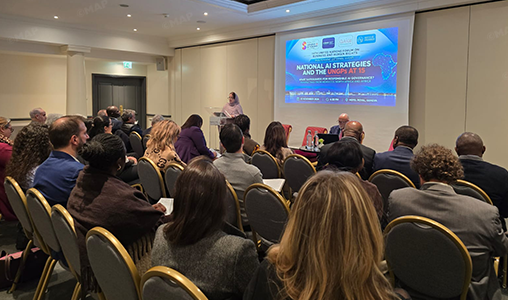
The need to reconcile digital sovereignty, technological innovation, and the protection of human rights, through better coordination of national and international regulatory frameworks, was the focus of a meeting held Monday evening in Geneva, on the sidelines of the 15th United Nations Forum on Business and Human Rights.
Initiated by the International Observatory for Peace, Democracy and Human Rights, Geneva (IOPDHR-GENEVA-NGO), in partnership with the Geneva AI Governance Institute (GAIGI), this event examined the perspectives of Morocco, North Africa, and the African continent in the face of the transformations brought about by artificial intelligence (AI), in light of the UN Guiding Principles on Business and Human Rights, adopted in 2011.
Expert Axel Mazolo, founder and executive director of GAIGI, highlighted the Moroccan experience as an illustration of the challenges of regulatory interoperability in AI, arguing that different national and regional frameworks must be able to recognize each other, without necessarily imposing a uniform global regulation. Referring to the “Morocco AI 2030” roadmap and the “Digital X.0” framework law, he emphasized the importance of aligning the requirements for transparency, explainability of algorithms, and respect for fundamental rights.
This mutual recognition of assessment mechanisms would, in particular, facilitate the activities of African companies operating in multiple markets, while preventing regulatory fragmentation from penalizing small businesses and individuals affected by automated decisions.
Addressing national ambitions, Karima Rhanem, an expert and strategist in artificial intelligence and communication, presented the guidelines of “Morocco AI 2030,” which are structured around sovereignty and trust, innovation and competitiveness, as well as impact and influence. This roadmap aims to generate 100 billion dirhams in added value, create 50,000 direct and indirect jobs, and train and certify 200,000 skilled individuals by 2030.
It also highlighted the role of the JAZARI Institutes in developing the national innovation ecosystem, as well as initiatives to adapt AI solutions to Moroccan linguistic realities, particularly through the processing of Darija (Moroccan Arabic). It emphasized the importance of cybersecurity, personal data protection, and skills development.
Opening the proceedings, Aicha Duihi, President of IOPDHR-GENEVA-NGO, stressed that automated systems can influence access to employment, justice, social benefits, and migration procedures.
Ms. Duihi called for fundamental rights to be placed at the heart of national AI strategies, warning against algorithmic discrimination, opaque systems, and privacy violations, particularly in the areas of employment, justice, and access to social benefits.
The challenges of access to justice were also addressed by Sanjeewa Liyanage, Director of International Programs at International Bridges to Justice (IBJ) in Switzerland. He emphasized that AI can facilitate legal information and connect detainees with lawyers, especially those from disadvantaged backgrounds, but it must never replace human legal assistance or fair trial guarantees. He advocated for independent human oversight, confidentiality of communications between lawyers and clients, and accessible, rapid, and free appeal mechanisms.
For his part, Biro Diawara, UN Affairs Program Officer at the African Meeting for the Defense of Human Rights (RADDHO), warned against the risks of disinformation, hate speech, and manipulation of public opinion linked to the use of AI. He called for multi-stakeholder governance involving states, businesses, and civil society, as well as strengthened international cooperation to develop standards ensuring that human dignity remains at the heart of technological development.
The speakers concluded by reiterating that AI development must be guided by the three pillars of the UN Guiding Principles: the obligation of states to protect human rights, the responsibility of businesses to respect them, and the guarantee of effective remedies and redress for those affected.
Related Articles

Gaza: Third Phase of Moroccan Humanitarian Aid Campaign

Moroccan Students Claim Grand Innovation Prize at Huawei ICT Global Final in China
Government Assures Readiness for 2025 AFCON, 2030 World Cup Arrangements on Track

Morocco's Energy Minister Outlines the Kingdom's Vision For Climate Financing In Africa
Morocco in the Spotlight at the 9th Africa Day in Vienna
Leave a Comment