

Creative Experiences of Three Winners of the Morocco Book Prize Honored
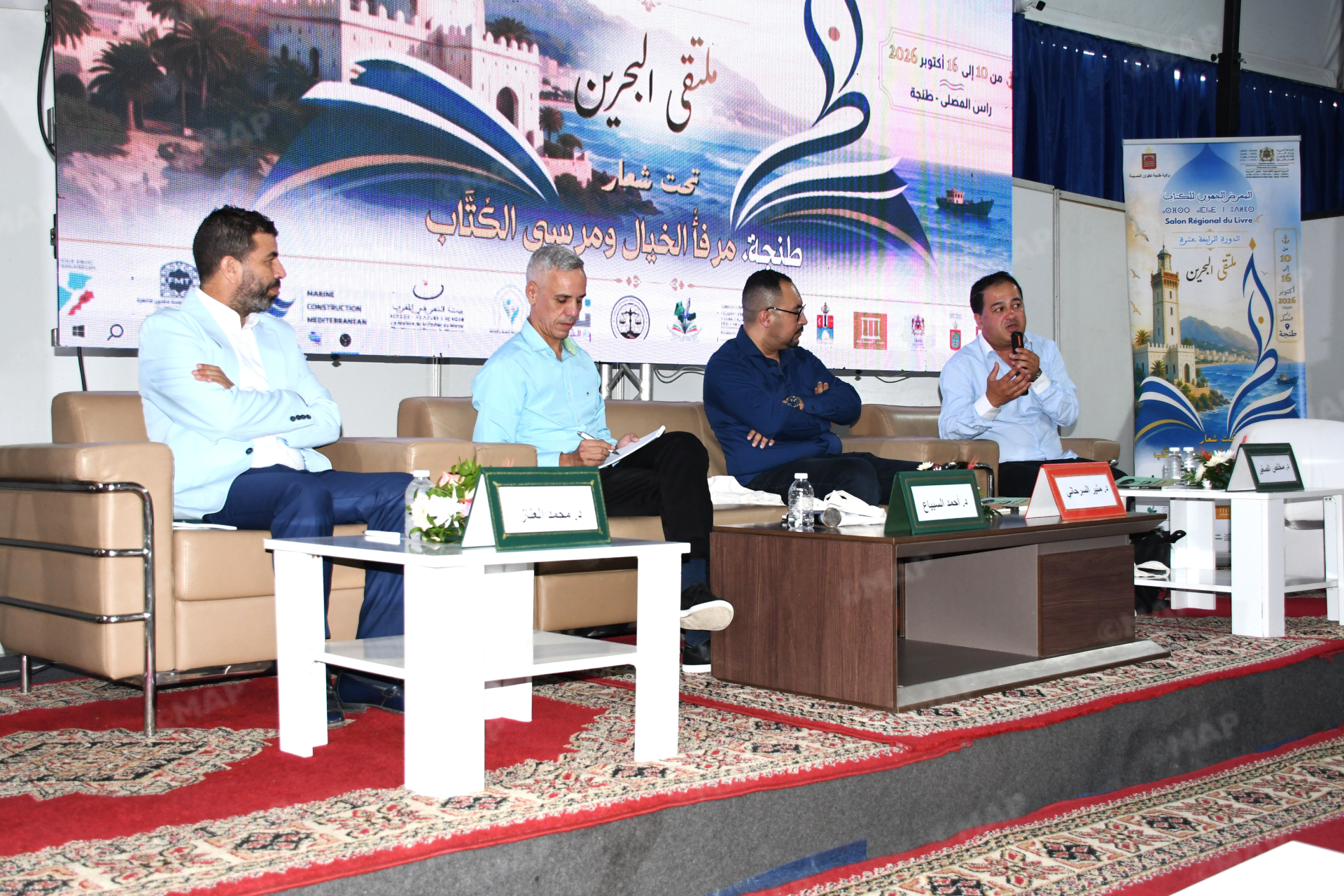
Tangier – The 14th edition of the Tangier Regional Book Fair honored, on Sunday, the literary journeys and creative experiences of poets Mokhliss Sghir and Mounir Serhani, as well as writer and playwright Ahmed Sbiaa, winners of the 2025 Morocco Book Prize in the categories of poetry and children’s and young adult literature.
Poets Mokhliss Sghir and Mounir Serhani jointly won the Poetry Prize, respectively for their collections “Al-Ard Al-Mawbou’a” (The Infested Land) and “Nasita hidha’aka ya abi” (Dad, You Forgot Your Shoes), while writer and playwright Ahmed Sbiaa and Abdelatif Aït Nila were jointly awarded the Children’s and Young Adult Literature Prize, respectively for their works “Album suwar farigh” (An Empty Photo Album) and “Al-Ibra adh-dhahabiyya al-ka’eeba wa qisas ukhra” (The Lugubrious Golden Needle and Other Stories).
Organized by the Regional Directorate of Culture of Tangier-Tetouan-Al Hoceima, this cultural event provided an opportunity to revisit the creative journeys of distinguished authors and highlight the unique aspects of their literary experiences, as well as the artistic and human dimensions that characterize their works.
Speaking at the event, poet Mokhliss Sghir, originally from Tetouan, discussed the motivations behind the publication of his collection “Al-Ard Al-Mawbou’a,” explaining that his poetic experience is rooted in pivotal existential moments that lead the writer to question reality and the act of writing itself. The collection notably reflects on the experience of the Covid-19 pandemic and the questions it raised about life, death, and human destiny.
The poet explained that this collection is a continuation of his creative journey, which continues with another collection entitled “Al-Ard Al-Hamra” (The Red Earth).
He emphasized that the earth is a central theme in his poetic experience, mentioning the possibility of dedicating a third collection to it to complete a “poetic program” focused on the relationship between humankind and the earth, and our destiny upon it.
Mr. Sghir stressed that poetic writing cannot be reduced to a mere accumulation of poems, but must be part of a coherent creative “program,” where the author’s visions and reflections resonate with the transformations that are affecting humanity and the world.
He also spoke of his attachment to the city of Tangier, which accompanied the early stages of his creative journey, notably through a radio program hosted by the late poet Ahmed Tribaq Ahmed on Radio Tangier. He highlighted the city’s role as a space conducive to the discovery and promotion of new voices in writing and poetry.
For his part, the poet and translator Mounir Serhani, originally from Ksar El Kébir, discussed his collection “Nasita hidha’aka ya abi,” which marks a pivotal moment in his creative career. This is his first poetic work in Arabic, following a literary path primarily dedicated to writing in French, in the fields of poetry and novels, as well as translation.
He explained that writing about his father, a teacher by profession and deeply attached to the Arabic language and its textual heritage, served as the starting point for this collection. This theme thus opened the way for him to write poetry in Arabic, in an experience where questions of identity, memory, and the relationship to language intersect.
For his part, the writer and playwright Ahmed Sbiaa, originally from Chefchaouen, highlighted the specificities of writing for children and teenagers, emphasizing the essential role of “ideas, suspense, and humor” in crafting literary texts adapted to the interests of this readership, through clear and engaging ideas.
He explained that his focus on writing for children and teenagers stems from his theatrical experience, with the desire to reach this young audience through published works, after some of his plays for children were unable to be staged.
Mr. Sbiaa stressed that writing for children and teenagers is no less demanding than writing for adults, as it requires real creative maturity and the ability to conceive ideas adapted to the specificities of this young audience and likely to arouse their interest.
Related Articles
El Jadida Horse Show 2026 Welcomes Nearly 160,000 Visitors

Moroccan Gastronomy Celebrated in Addis Ababa
Kick-off of the 8th Marrakech Folklore Days Festival
El Jadida Horse Show: Between the Heritage of Tbourida and the Excellence of the Morocco Royal Tour

Culture Minister ‘Proud of Morocco as Guest of Honor’ at 2025 Paris Book Festival’s Inauguration
Leave a Comment